Showing posts with label definition. Show all posts

Sunday, July 15, 2012

Know The Difference: Heart Attack vs Cardiac Arrest

Welcome to the second installment of "Know the Difference," a series which seeks to clear up common medical misnomers. This week, we're tackling a one of the most prominent naming errors on television (and by extension, the public). The scene is a hospital room, with the patient lying in the bed looking quite unhappy and ill. In walk our doctors, who bear an uncanny resemblance to team featured on House. They chat with the patient briefly, exchange some comical banter with each other, and then the patient takes a turn for the worse. The camera pans up to the cardiac monitor, which shows a complete asystole (flat line). Everyone springs dramatically into action, but one of the doctors commits a medical student faux paus. "She's having a heart attack!" he exclaims, sending a brief jolt of pain to the frontal lobes of the clinical staff watching at home.

So what happened? Basically the hotshot doctor was confusing two conditions, heart attack and cardiac arrest. And since they are treated very differently, it is kind of a big deal to get it right. So how do you tell one from the other?

A cardiac arrest (CA) occurs when the heart is no longer pumping blood. This is determined clinically by checking for a pulse. If it is absent, congratulations; you now have a genuine emergency on your hands. When the heart stops pumping blood, oxygen and nutrients cannot circulate through the body, and waste begins to build up. Without intervention, CA is fatal in a matter of minutes (predominantly due to the lack of oxygen)(1). CA is treated differently depending on the cause and EKG interpretation. For instance, the most common one seen on TV is asystole:
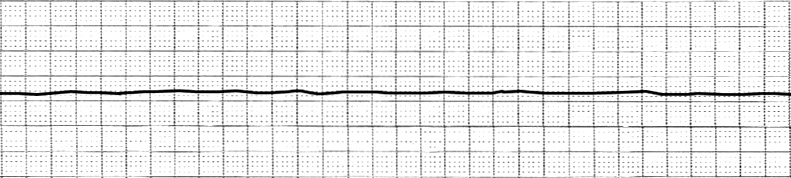
Asystole. Note no discernible waves. Courtesy of wikipedia.
This is also the most common rhythm seen in Out-of-Hospital arrests(2). Asystole has a number of causes, some reversible some not. Typically, this rhythm is seen after prolonged pulselessness, so the prognosis is grim. The treatment usually involves reversing the underlying condition (toxicity, tamponade, tension pneumo, etc). What it does not involve is electrical shocks. Asystole is not a shockable rhythm. So, while making for very good television, our team of doctors would not be doing any good with the defibrillator in the typical case. Ventricular fibrillation (V-fib or VF) on the other hand, is shockable, even though it may not look like an abnormal rhythm to the untrained eye.
V-fib. Only random waveforms. Also courtesy of wikipedia.
VF is a pulseless rhythm where the heart is contracting randomly, out of sync. 

A heart attack (MI) is also a serious condition, but does not lead to death per se. An MI occurs when blood flow to the heart is reduced, classically causing chest pain (angina) and dyspnea(2). The reduction of blood flow is usually due to a narrowing in one or more of the coronary arteries. Thus, the primary intervention is to open the arteries back up (PCI) or bypass blocked portions (CABG). The main difference between MI and CA is that cardiac arrest is a complication of an MI. If the blood flow is cut off for too long, heart muscle (myocardium) will die. This can lead to arrhythmias or heart failure, which may lead to death. The EKG of a person having a heart attack can vary substantially, but here are some examples of anterior MIs.

Summary
CA: No pulse, heart is not pumping blood. Rapidly fatal. Treatment (resuscitation) depends on the rhythm appearance.
MI: Reduced blood flow to the heart via the coronary arteries. Muscle death may impair normal function of the heart and lead to death.

So the next time you're watching House or Gray's Anatomy (or ER for the slightly older readers), keep an eye on that monitor and get ready to call those actors out on their mistakes!

Sources
1.CPR - adult. PubMed Health. 2011. http://www.ncbi.nlm.nih.gov/pubmedhealth/PMH0001083/. Accessed July 15, 2012.
2. Mader TJ, et al. Out-of-hospital cardiac arrest outcomes stratified by rhythm analysis. Resuscitation (2012), http://dx.doi.org/10.1016/j.resuscitation.2012.03.033.
3. Heart Attack. PubMed Health. 2011. http://www.ncbi.nlm.nih.gov/pubmedhealth/PMH0001246/. Accessed July 15, 2012.

Friday, May 11, 2012

Behavior: It's What You Do!

As far as undergraduate majors go, psychology is typically one of the more popular ones. This occurs for a variety of reasons, but I suspect the relatively easy course material plays the dominant role. Psychology has the sophisticated appearance of a science without all that pesky scientific rigor and prerequisite chemistry and biology work (not actually true). The theories and concepts put forth by people like Descartes and Freud sound very scientific and appear to explain why people act as they do. Unfortunately, Freud's theories suffer from the problem of being completely un-testable, which just doesn't fly with those who practice the scientific method. Additionally, his data came primarily from case studies, which are great for identifying problems and events that need explaining, but cannot be used as compelling empirical evidence. Despite this, pop psychology is immensely, um, popular because it uses cool words like transference and cognition and describes events we can relate to. But those are problems for another day. Instead, I am going to introduce behavior and how I was trained to view psychology from a behavioral perspective.

Behavior can be defined in several ways. So far, the most useful definition comes from a functional standpoint: A behavior is an action that solves an adaptive problem. An adaptive problem is a fancy term for some event that affects your fitness (reproductive success). For instance, say you are out for a nice evening stroll through the park. It is a pleasant night, and although you are annoyed that Tom didn't fax his request for additional copy paper before leaving for the day, you are ultimately in a good mood. As you pass by the rock formation shaped in the uncanny likeness of John Belushi, you encounter a very aggressive-looking lion. The presence of the lion (called the context, more on that later) presents you with an adaptive problem: Your fitness will decrease substantially if the lion is allowed to solve his adaptive problem (to my knowledge, there are no cases of successful reproduction when one partner is deceased. The internet may suggest otherwise). In any case, your response to the lion is a behavior. It might consist of fighting the lion, running away from the lion, bargaining with your choice of higher power, or attempting to persuade the lion that you are not a suitable source of food (what you end up doing depends on your behavioral and evolutionary history, but again, more on this later). What matters is that you were presented with a problem that would affect your fitness, and you responded in a manner to address that problem. Even mundane activities such as driving to work, checking your mail, and watching TV can be called adaptive problems, because they affect your ability to acquire/distribute resources or attract a mate. Behavior is everywhere, and you are doing it all the time.

(As a clarification, behavior is specifically what you do, never what you are not doing. Avoiding your homework is not a behavior because it fails the so called "dead-man test." If a dead person can do it, it isn't behavior) (Malott & Suarez, 2004)

There is also a special type of behavior that describes the transfer of information (essentially cues) between individuals. We, unimaginatively perhaps, call this type of behavior verbal behavior. Your speech and non-verbal communication is considered behavior because again, it solves adaptive problems (and involves a verbal episode, which is the exchange of discriminative stimuli). You might say, "Honey, please pass the salt" or "Did I tell you about the time I was attacked by a lion?" to initiate the verbal episode. The other person will respond, either continuing or concluding the episode. Verbal behavior also includes nonverbal actions like facial expressions, body language, sign language, and even ordinary signs, like those you might see on the road or warning you to wear a hard hat. Remember, if you do it, it is behavior (pending passing the dead man test).

Behavioral psychologists are usually less interested in the behavior itself, and more interested in the adaptive problems it may solve. Often times it is unclear what adaptive function a behavior serves, as in schizophrenia or depression. Sometimes the adaptive function is diminished over time or disappears entirely, but the behavior continues anyways, such as using eating utensils or consuming high-caloric foods. Luckily, the very principles that lead behavior astray can also help fix it.

Behaviorism is not a complicated subject. Many of the concepts and principles are intuitive and similar to concepts in other sciences (especially with respect to evolutionary theory). The core philosophy of behaviorism though, drastically contrasts the popular, dualistic notions of psychology, and it can be profoundly difficult to unlearn those notions. I promise however, that once you start seeing the world through behavior-colored lenses, it becomes much easier to identify problems and institute actions to fix them. After all, behavior is what you do. What could be simpler than that?


My information comes from my behavioral psych professor and these two books (both available on Amazon). If you're looking for much more detail on behaviorism and behavior, give these a read:
1. Principles of Behavior by Richard Malott and Elizabeth Suarez.
2. Understanding Behaviorism: Behavior, Culture, and Evolution by William Baum.